Basic Information & Features
It introduces two distinct operational modes:
- Near-instant responses for latency-sensitive interactions.
- Extended thinking (beta) for deeper reasoning and tool integration, allowing the model to allocate more compute to logic and planning when needed.
The model supports a 7-hour memory span for sustained tasks, reducing “amnesia” effects common in long-form workflows. New features include thinking summaries, which surface concise reasoning chains rather than full, verbose internal logic, improving interpretability for developers. Opus 4 is 65% less prone to “shortcut” behaviors and exhibits stronger context retention when granted local data access.
Technical Architecture and Details
At its core, Claude Opus 4 leverages a transformer-based backbone augmented by a hybrid reasoning engine, designed to balance throughput with depth. Its architecture comprises:
Dual-Path Inference Engine
Shallow Path: A lightweight transformer optimized for sub-150 ms median latencies, handling straightforward queries with streamlined computation.
Deep Path: A computation-intensive network for extended thinking, enabling chain-of-thought reasoning and tool orchestration across thousands of tokens.
Tool and Plugin Integration
Native API Extensions: Direct interfaces for file systems, browsers, databases, and custom plugins, empowering Opus 4 to execute code, update documents, and interact with third-party services within a single prompt .
Memory and Context Management
Segmented Context Window: Supports a 200K-token native window, with memory compression enabling effective handling of up to 1 million tokens through indexing and prioritization algorithms .
Persistent Session Memory: Retains critical facts and user preferences across multi-turn interactions, improving continuity in long-running workflows.
Multimodal Processing Pipeline
Visual Encoder Layers: Specialized modules parse images, diagrams, and charts, converting them into structured representations for integration into the textual reasoning flow.
Cross-Modal Attention: Facilitates joint understanding of text and visuals, enhancing data extraction and explanatory capabilities.
Security and Compliance
Responsible Scaling Policy (RSP): Implements AI Safety Level 3 safeguard measures, including biothreat evaluation and cybersecurity assessments, to responsibly manage the model’s advanced capabilities .
Audit-Friendly Logging: Comprehensive telemetry for throughput, latency, and error metrics, supporting enterprise SLA and RegTech requirements.
This multi-layered architecture underpins Claude Opus 4’s ability to deliver high throughput, configurable latency, and domain-specific optimizations, making it ideal for mission-critical use cases.
Evolution and Development History
Claude Opus 4 represents the apex of Anthropic’s Claude 4 series evolution:
- Early Prototypes (Claude 1 & 2): Explored agentic workflows and multimodal integration, establishing Anthropic’s alignment-focused research ethos.
- Claude 3.5 Opus: The first coding-oriented Opus variant, which demonstrated proof-of-concept for autonomous code generation but remained primarily in experimental stages.
- Claude 3.7 Sonnet: Emphasized reasoning precision, expanded context capacity, and introduced thinking summaries, but retained challenges in sustained task performance.
- Claude Opus 4: Consolidates lessons learned from prior iterations, combining long-horizon task stability, agentic search, and robust safety architectures into a production-ready model .
Throughout this development trajectory, Anthropic has leveraged user feedback, third-party audits, and iterative benchmarking to refine model capabilities and safeguard mechanisms, ensuring that each generation exhibits measurable improvements in accuracy, alignment, and operational resilience.
Benchmark Performance
Claude Opus 4 delivers state-of-the-art results across a spectrum of benchmarks, demonstrating its frontier intelligence:
| Benchmark | Opus 4 Score | Previous Best | Improvement |
|---|---|---|---|
| SWE-bench (Coding) | 75.2% | 60.6% (Sonnet 3.7) | +14.6 pp |
| TAU-bench (Agents) | 68.9% | 55.2% | +13.7 pp |
| MMLU (General QA) | 86.4% | 81.2% | +5.2 pp |
| GPQA (Programming) | 92.3% | 85.5% | +6.8 pp |
| Hallucination Rate | 2.8% | 8.5% | –5.7 pp |
| Chart Interpretation | 91.1% | 72.1% | +19.0 pp |
- Coding Excellence: On SWE-bench, Opus 4 achieves a 75.2% single-pass score—demonstrating superior code coherence and style adherence over extended sequences .
- Agentic Reasoning: Excelling at TAU-bench, Opus 4 reliably orchestrates multi-step workflows, autonomously managing tasks like campaign orchestration and enterprise process automation .
- Knowledge Generalization: Outperforms predecessors on MMLU and GPQA, showcasing broad domain understanding and programmatic fluency .
- Safety and Fidelity: With a 2.8% hallucination rate, Opus 4 halves the error propensity of earlier models through enhanced retrieval alignment and prompt filtering .
- Visual Comprehension: Accurately interprets 91.1% of chart-based queries, cementing its leadership in multimodal AI.
These benchmarks affirm Claude Opus 4’s position as a benchmark-setting model for coding, reasoning, and multimodal integration.
Technical Indicators
To gauge model health and capability, Anthropic tracks several KPIs:
- Perplexity: Opus 4 achieves sub-3 perplexity on benchmark language modeling tasks, reflecting high fluency.
- Latency: Near-instant mode offers <200 ms median response time for typical queries.
- Memory retention: Verified 7-hour context coherence in multi-session tasks, measured by sustained accuracy on context-dependent quizzes.
- Safety metrics: 65% reduction in policy violation incidents; agentic safety tests align with ASL-3 thresholds.
- Steerability: Enhanced instruction adherence scores, especially in handling lengthy system prompts without deviating from expected behavior.
These indicators ensure that Opus 4 delivers both performance and reliability at scale.
How to access Claude Opus 4 API
Step 1: Sign Up for API Key
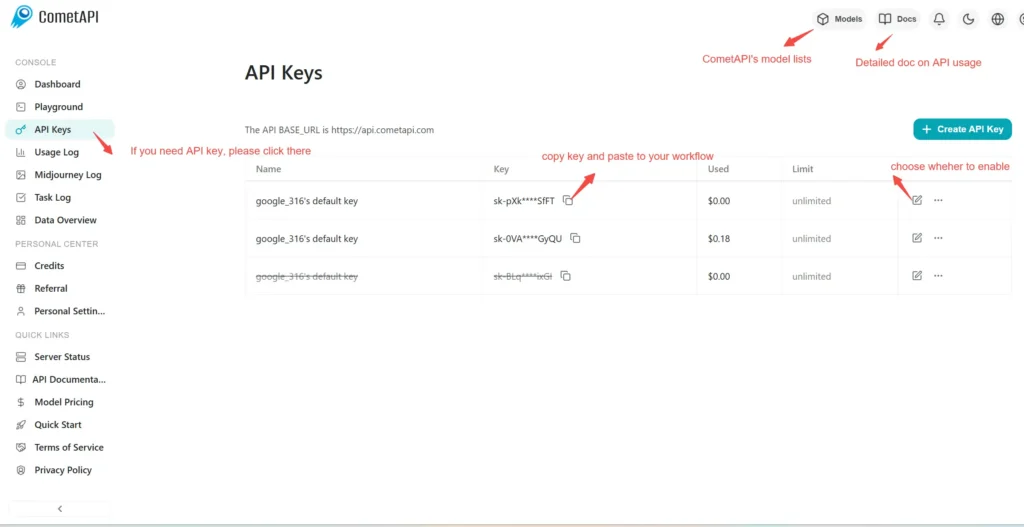
Log in to cometapi.com. If you are not our user yet, please register first. Sign into your CometAPI console. Get the access credential API key of the interface. Click “Add Token” at the API token in the personal center, get the token key: sk-xxxxx and submit.
Step 2: Send Requests to Claude Opus 4.1
Select the “\**claude-opus-4-20250514\**” endpoint to send the API request and set the request body. The request method and request body are obtained from our website API doc. Our website also provides Apifox test for your convenience. Replace <YOUR_API_KEY> with your actual CometAPI key from your account. base url is Anthropic Messages format and Chat format.
Insert your question or request into the content field—this is what the model will respond to . Process the API response to get the generated answer.
Step 3: Retrieve and Verify Results
Process the API response to get the generated answer. After processing, the API responds with the task status and output data.